We surround ourselves with things. Our homes are filled with furniture, decorations, appliances, gadgets, and knickknacks that make our lives more comfortable and bring us joy.
But when surveyed, 80% of homeowners said they felt like their space was cluttered or crowded.
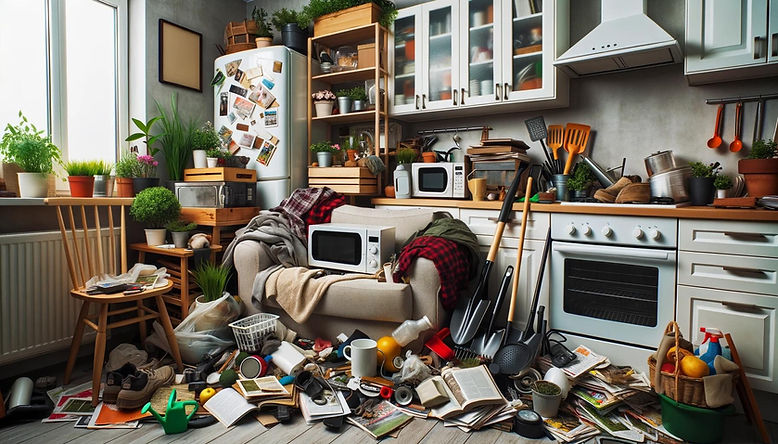
Our homes are filled to the brim with items we rarely use. Studies show the average American home has 300,000 things, from knick-knacks to appliances, and 25% of people with two-car garages have to park their cars outside due to clutter!
The problem isn’t a lack of storage solutions—it’s simply owning more than we need or use.
This excess “stuff” has real costs, like increased financial burden and decreased wellbeing (clutter can lead to depression and even obesity).
This article will teach you a little bit more about the stuff we own, and hopefully these statistics on clutter may inspire you to declutter your life.
General Clutter Statistics
- 69.3% feel they have an issue with clutter. (source)
- 81.22% feel they have too much stuff. (source)
- 94.42% find a clutter-free home important. (source)
- 99.19% feel better after decluttering. (source)
- 33.99% don’t declutter due to lack of time, while 24.72% don’t know how to. (source)
- A full 80% of the things people hang onto are never actually used again. (source)
- Individuals spend a total of 3,680 hours or 153 days over their lifetime searching for misplaced items. On average, up to nine items are lost every day, with phones, keys, sunglasses, and paperwork topping the list of commonly misplaced items. (source)
- 60% of people have been late to work or school because of lost items; 49% have missed appointments or meetings; and 22% missed flights, trains, or bus rides. (source)
- As of 2019, the average number of apparel items owned by consumers worldwide stood at 136. (source)
- Clutter leads to increased levels of cortisol, a stress hormone, and can trigger negative emotions such as depression. (source)
- For women, stress levels directly correspond to the amount of clutter in their home. (source)
- People living in cluttered environments tend to eat more junk food, and people in cluttered homes are over three quarters more likely to be overweight. (source)
- In the average home, getting rid of clutter eliminates 40% of the housework. (source)
In the United States
- The average home in America contains 300,000 items. (source)
- Americans spend $1.2 trillion annually on nonessential goods, items not necessary for daily living. (source)
- Americans spend $38 billion annually on storage units. (source)
- 10% of Americans rent off-site storage. (source)
- 80% of storage units are used for household items. (source)
- Nearly 1 in 5 renting a storage unit already have a sizable house with 4 or more bedrooms. (source)
- America has more self-storage units than Starbucks and McDonald’s locations put together – over 50,000 in total. (source)
- 25% of people don’t have enough space in their garage to park their car inside. (source)
- Half of Americans say their garage is the most disorganized part of their home. (source)
- When asked how they could like their garage more, the top response was simply “removing junk.” (source)
- 25% of people with two-car garages can’t park a car due to clutter. (source)
- Americans spend nearly $3 billion annually replacing misplaced items, with most people spending up to $50 per year on replacements. (source)
- The average American spends 2.5 years of their life looking for lost or misplaced items. (source)
- 9 million hours per day are wasted in the USA by people who can’t find objects due to clutter. (source)
- The average American makes 12 impulse purchases a year, according to new research. (source)
- Average American spends $151 on impulsive purchases per month. (source)
- Even though only 3.1% of the world’s children live in America, they own 40% of the toys consumed globally. (source)
In the UK
- 90% people in the UK have clutter in their homes, while only 7.4% say they have none at all. (source)
- 47.2% of UK residents think that clutter in their home makes them feel stressed. (source)
- Nearly half of people hoard stuff they don’t need, and one in five describe their home as “fairly cluttered.” (source)
- Nearly one in three people have gotten into an argument with their partner or roommate over clutter. (source)
- 10 percent have a room they can’t use, because it’s full with junk. (source)
- About half of people spend between one and two hours decluttering their home, while a quarter of people spend nearly four hours doing it! (source)
- British research revealed that the average 10-year-old owns 238 toys but only plays with 12 daily. (source)
In Australia
- In a survey conducted in Australia in 2022, about 25% of respondents mentioned owning between one and five fashion items that they had not used over the last year 3.
- 88% of homes have at least one cluttered room, and the average home has three or more cluttered rooms. (source)
- 40% of Australians say they feel anxious, guilty or depressed about the clutter in their homes. (source)
- Over half of women have a room in their house that they’re embarrassed to show visitors because of the clutter. (source)
- 20% of Australians had built a shed or garage to keep or store things. (source)
- One in eight had even moved house to accommodate their superfluous ‘stuff’! (source)
In Canada
- 91% of Canadians believe that their life is negatively impacted by clutter. (source)
- 21% of Canadians admit that they have at least a couple of rooms in their house that are out of control. (source)
- 12% say that clutter causes arguments with other family members. (source)
- 44% blame the hassle associated with getting rid of unwanted items for the clutter. (source)
How about you? How much clutter do you have in your life?